Creating Unique Activity Books with a 200 Mixed Level Sudoku Puzzle Template for KDP
The self-publishing landscape has evolved significantly over the last decade, transforming from a niche hobby into a viable business model for creators, educators, and entrepreneurs. Among the most enduring categories in this space is the activity book market, specifically puzzle books. Sudoku remains a titan in this genre due to its universal appeal and cognitive benefits. However, for aspiring publishers using Amazon Kindle Direct Publishing (KDP), creating high-quality puzzle interiors from scratch can be a daunting technical hurdle. This is where specialized digital assets, such as the 200 Mixed Level 9x9 Sudoku Puzzles Book template, become essential tools for success.
Understanding how to leverage pre-made, editable puzzle templates is not just about saving time; it is about understanding the architecture of a successful low-content or medium-content book. This article explores the practical application of a 200-puzzle mixed-level Sudoku interior, detailing how to customize it, adhere to KDP technical standards, and create a unique product that stands out in a crowded marketplace.
Understanding the Asset: What Is Included and Why It Matters
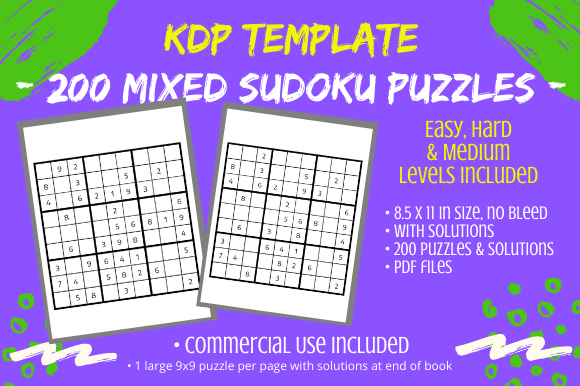
Before diving into customization, it is crucial to understand exactly what constitutes a professional-grade puzzle template. The 200 Mixed Level Sudoku resource is designed specifically for the 8.5 x 11 inch trim size, which is the industry standard for adult activity books. This specific dimension offers ample white space and large print options, which are significant selling points for older demographics or those with visual impairments.
The package typically includes two distinct PDF files:
- The Puzzle File: Contains 200 pages of unique 9x9 grids categorized by Easy, Medium, and Hard levels.
- The Solution File: A separate 50-page document containing the answer keys for all 200 puzzles.
A critical technical specification to note is the NO-bleed setting. In printing terminology, "bleed" refers to artwork that extends beyond the edge of the page. For puzzle books, no-bleed is often preferred because it ensures that grid lines and numbers remain safely within the margins, preventing them from being trimmed off during the manufacturing process. This safety margin reduces the risk of rejected uploads on KDP and ensures a cleaner reading experience.
It is important to clarify what is not included. These templates generally do not provide covers, title pages, or copyright pages. This exclusion is intentional. It forces the creator to add their own branding and front matter, ensuring that the final product is original rather than a duplicate of another seller's work.
The Strategic Value of Mixed Difficulty Levels
One common mistake new publishers make is releasing books that target only a single difficulty level. While niche books have their place, a mixed-level approach significantly broadens your potential audience. By including Easy, Medium, and Hard puzzles in a single volume, you cater to multiple user intents simultaneously.
Consider the modern consumer's lifestyle. An easy puzzle might be perfect for a quick mental warm-up during a morning commute or a coffee break. A medium puzzle serves as a satisfying lunchtime challenge, while hard puzzles are reserved for dedicated evening sessions or long travel days. By bundling these experiences, you increase the perceived value of the book. From an SEO perspective, this also allows you to target a wider array of keywords, ranging from "beginner sudoku" to "expert logic puzzles," within a single listing.
Customization: Transforming a Template Into a Unique Product
The most vital aspect of using any digital puzzle asset is customization. Amazon’s algorithms prioritize unique content, and customers can easily spot generic, unedited templates. The 200 Mixed Level Sudoku book is designed to be edited via any online PDF converter or desktop publishing software. This flexibility allows you to deconstruct and reconstruct the asset to fit your specific vision.
Practical Editing Strategies
To make this template truly your own, consider the following modification strategies:
- Rearrange the Sequence: Do not simply publish the puzzles in the order they appear in the source file. Shuffle the difficulty levels to create a progressive curve or a randomized "daily challenge" feel. You might group them as 10 Easy, 10 Medium, and 10 Hard in repeating cycles to maintain reader engagement.
- Add Complementary Content: Use the PDF editor to insert coloring pages, inspirational quotes, or trivia facts between puzzle sections. This breaks up the monotony of grid-after-grid and transforms a simple puzzle book into a holistic "activity book" or "mindfulness journal."
- Modify Page Titles and Headers: Change generic headers like "Puzzle 1" to thematic titles. If your book targets travelers, rename sections to "Airport Warmups" or "In-Flight Challenges." Thematic consistency builds brand identity.
- Integrate Branding Elements: Add your logo, website URL, or social media handles to the footer or header areas. Since the template is no-bleed, you have safe zones to add these elements without worrying about trim errors.
FYI – Before you begin editing, always create a duplicate copy of the original files. Keeping a pristine master copy ensures you can revert to the source material if you make an error or decide to create a second variation of the book later.
Technical Considerations for KDP Success
Even with a high-quality template, technical execution determines whether your book gets published. When working with the 8.5 x 11 inch no-bleed format, you must ensure your final PDF matches these dimensions exactly. Mismatches in page size are the most common reason for upload failures.
Furthermore, pay close attention to the solution section. Solutions should be formatted efficiently—often four to six solutions per page—to keep the total page count manageable. A 200-puzzle book with 200 pages of puzzles plus 50 pages of solutions results in a 250-page interior. This is a substantial spine width, which looks professional on a bookshelf. However, if you add significant extra content during customization, recalculate your spine width before designing your cover to avoid misalignment.
Educational and Cognitive Relevance in Modern Life
Beyond the business mechanics, it is helpful to understand why this product matters to the end-user. In an era dominated by digital screens and fleeting attention spans, physical puzzle books offer a tangible form of "digital detox." Educators and therapists frequently recommend Sudoku for developing logical reasoning, pattern recognition, and patience.
For adults, these puzzles serve as accessible cognitive maintenance. Research suggests that engaging in regular mental exercises can support brain health as we age. By providing a mixed-level resource, you are essentially offering a scalable workout plan for the mind. Beginners are not intimidated by immediate complexity, while advanced players are not bored by simplicity. This adaptability makes the mixed-level format particularly relevant for senior centers, classrooms, and rehabilitation settings where users have varying capabilities.
Common Misunderstandings About Puzzle Templates
New publishers often harbor misconceptions about using pre-made interiors. Addressing these is key to long-term success.
Misconception 1: "Using a template means my book isn't original."
Reality: Originality in low-content publishing comes from curation, design, and user experience, not necessarily from hand-coding every grid. Just as a novelist uses standard grammar to tell a unique story, a puzzle publisher uses standard grids to create a unique compilation. The value lies in how you package and present the content.
Misconception 2: "I can just upload the PDF as-is."
Reality: While technically possible, this is strategically unsound. Duplicate content filters may suppress your book, and customers who recognize the generic layout will leave negative reviews. Always treat the downloaded file as raw clay, not a finished sculpture.
Misconception 3: "More puzzles always equal better sales."
Reality: Quality and organization trump sheer volume. A well-curated 200-puzzle book with clear formatting, accurate solutions, and thoughtful progression will consistently outsell a sloppy 500-puzzle book. The 200 Mixed Level template hits a sweet spot of quantity and manageability.
Building a Sustainable Publishing Workflow
Incorporating resources like the 200 Mixed Level Sudoku Puzzles Book into your workflow allows for rapid iteration. Because the heavy lifting of puzzle generation and verification is already done, you can focus your energy on market research, keyword optimization, and cover design—the factors that actually drive sales.
This modular approach also facilitates series creation. Once you have mastered customizing the Sudoku template, you can apply the same principles to other game types. You might eventually mix Sudoku with word searches or mazes, using the same 8.5 x 11 no-bleed framework to create a cohesive brand of activity books. The ability to take apart the booklet and mix or match it with other game types is perhaps its most powerful feature for long-term business growth.
Ultimately, this digital product is more than just a collection of grids; it is a foundation. Whether you are an educator creating classroom supplements, a caregiver compiling activities for seniors, or an entrepreneur building a passive income stream, understanding how to properly utilize and customize these assets bridges the gap between having an idea and holding a published book in your hands. By respecting the technical requirements, embracing customization, and focusing on the user's cognitive journey, you transform a simple PDF download into a valuable resource for puzzle lovers everywhere.