Evaluating 350 Samurai Sudoku Hard Level Vol 5 for Low-Content Publishing
The low-content publishing market has matured significantly, moving beyond simple lined journals to complex activity books that demand higher production standards. For creators targeting the adult puzzle niche, 350 Samurai Sudoku Hard Level Vol 5 represents a specific type of commercial asset designed to bridge the gap between concept and published product. This resource is not merely a collection of puzzles; it is a pre-formatted interior solution aimed at publishers who understand that activity books convert well but often lack the technical bandwidth to generate thousands of unique, interconnected grids manually. Understanding the practical utility of this volume requires looking past the novelty of Samurai Sudoku and evaluating it as a component in a broader publishing workflow.
Defining the Asset and Its Market Position
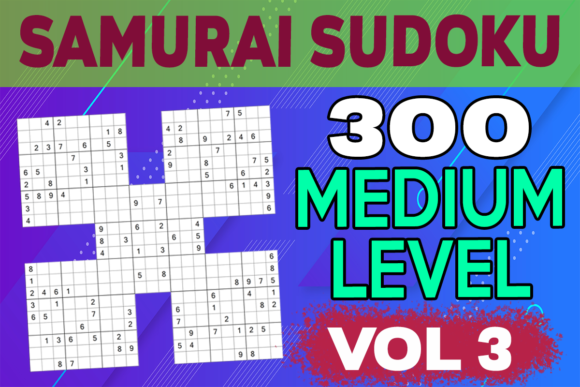
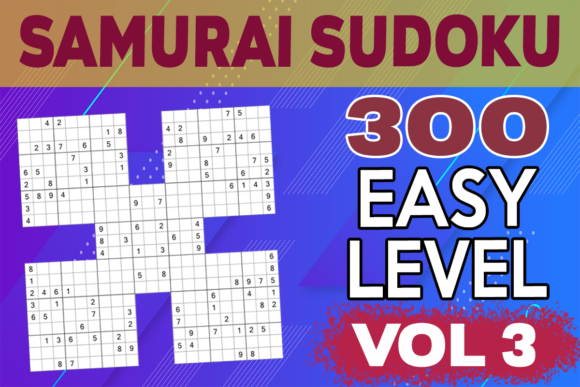
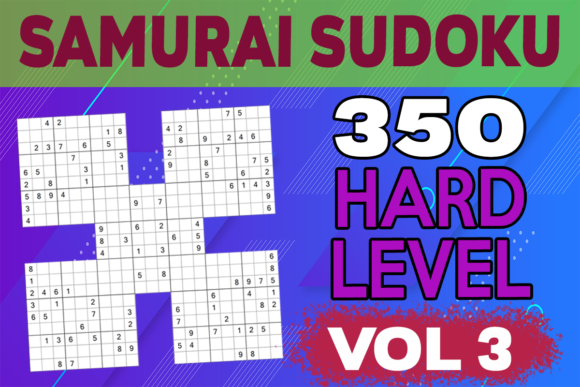
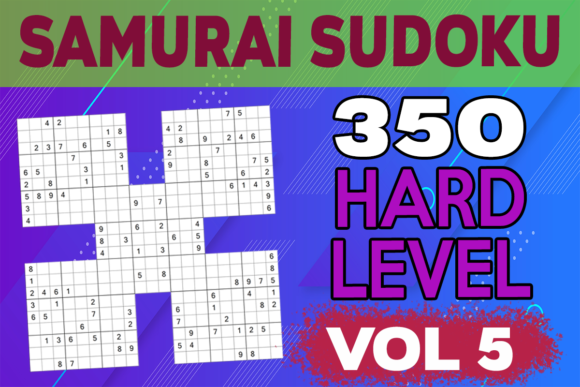
Samurai Sudoku differs from standard Sudoku by overlapping five grids into a single cohesive challenge. This format inherently appeals to serious hobbyists and experienced solvers who find traditional 9x9 grids repetitive. 350 Samurai Sudoku Hard Level Vol 5 capitalizes on this demand by providing a substantial volume of content specifically calibrated to a hard difficulty rating. The inclusion of 700 PNG files—comprising both puzzles and their corresponding solutions—signals that this product is engineered for print-on-demand (POD) platforms like Amazon KDP or IngramSpark.
From a strategic perspective, this asset addresses the primary bottleneck in puzzle book creation: interior generation. Developing valid Samurai Sudoku algorithms that maintain unique solutions across overlapping regions is computationally intensive and time-consuming. By acquiring a pre-made interior, publishers effectively outsource the most technically demanding phase of production. This allows creators to focus their limited resources on cover design, keyword research, and marketing strategies rather than debugging grid logic. The "Hard Level" designation is particularly relevant here, as the adult demographic driving puzzle book sales typically seeks cognitive engagement over casual distraction.
Technical Specifications and Production Quality
When evaluating digital assets for commercial use, file format and resolution are non-negotiable metrics. The delivery of 700 PNG files suggests a focus on visual fidelity. Unlike vector formats which are scalable but sometimes difficult to manipulate in certain layout software, high-resolution PNGs offer a plug-and-play compatibility with tools like Canva, Affinity Publisher, and Adobe InDesign. For a paperback interior, crisp lines and clear numerals are essential for user satisfaction; blurry or pixelated puzzles result in negative reviews and returns.
The separation of puzzles and solutions is a critical organizational feature. In professional puzzle book formatting, solutions are rarely placed adjacent to the active puzzle. They are typically aggregated at the back of the book or organized in a separate section to preserve the solving experience. Having these assets provided as distinct files streamlines the pagination process. A publisher can batch-import the 350 puzzle images for the front matter and subsequently arrange the solution keys without needing to manually crop or edit individual pages. This structural organization reduces the assembly time from days to hours, directly impacting the speed-to-market for new titles.
Workflow Integration and Practical Application
Integrating 350 Samurai Sudoku Hard Level Vol 5 into a publishing workflow requires a realistic understanding of what the asset provides versus what remains the creator's responsibility. While the interior content is handled, the asset does not constitute a finished book. Creators must still manage trim size selection, margin calculations, and bleed settings appropriate for their chosen POD platform. Because Samurai Sudoku grids have a unique aspect ratio compared to standard puzzles, verifying that the PNG dimensions align with your intended page size is a necessary first step.
For entrepreneurs managing multiple titles or building a brand around cognitive fitness, consistency is key. Using a standardized volume like this ensures that the difficulty curve and visual style remain uniform across a series. If you have previously published Volumes 1 through 4, this fifth installment maintains continuity for returning customers. However, if this is your entry point into the niche, be aware that relying solely on purchased interiors means your core content is non-exclusive. To mitigate this, successful publishers often combine such assets with unique value propositions, such as custom introductions, themed covers, bonus content, or proprietary branding elements that distinguish their edition from others using similar source material.
Audience Fit and Strategic Considerations
This resource is best suited for a specific subset of the low-content community. It offers immediate value to:
- Time-Constrained Publishers: Professionals who treat publishing as a volume business and cannot justify 40+ hours of interior design per title.
- Niche Expanders: Creators with existing audiences in adjacent niches (e.g., mindfulness, senior care, education) looking to test the puzzle market with minimal risk.
- Non-Technical Creatives: Designers and marketers who excel at packaging and sales but lack the programming skills to generate valid overlapping Sudoku grids.
Conversely, this asset may not fit creators whose primary selling point is artisanal, hand-crafted uniqueness or those who wish to build proprietary software tools for long-term IP generation. Additionally, educators seeking to use these puzzles for classroom instruction should verify that the "Hard" level aligns with their students' capabilities, as Samurai Sudoku introduces spatial complexity that can frustrate beginners regardless of numerical difficulty.
Evaluating Long-Term Value and Limitations
The decision to utilize 350 Samurai Sudoku Hard Level Vol 5 should be weighed against long-term business goals. The immediate advantage is obvious: a professional-grade interior ready for deployment. The 350-puzzle count is sufficient for a robust paperback (typically 150–200 pages depending on formatting), providing perceived value to the end consumer. The "Hard" difficulty targets a loyal segment of the market less sensitive to price fluctuations than the casual solver demographic.
However, users must navigate the reality of non-exclusive licensing. In saturated marketplaces, differentiation becomes paramount. Relying entirely on stock interiors without adding external value can lead to commoditization. Successful implementation involves treating this volume as a foundation rather than the entire structure. Consider how the puzzles are presented: Are there instructions tailored to seniors? Is there space for notes? Does the cover art signal premium quality? These factors determine conversion rates more than the raw puzzle count alone.
Furthermore, quality assurance remains the publisher's duty. Even professionally generated assets can contain anomalies. Before publishing, it is prudent to spot-check a random sampling of puzzles and solutions to ensure validity and alignment. Testing the printed proof is equally important to verify that the overlapping regions are visually distinct and that the gray shading (if present) reproduces clearly in grayscale printing. These diligence steps protect your brand reputation and prevent customer dissatisfaction.
Making an Informed Acquisition Decision
Ultimately, 350 Samurai Sudoku Hard Level Vol 5 serves as a functional tool for scaling low-content publishing operations. It solves the specific problem of complex interior creation while maintaining the quality standards expected by adult puzzle enthusiasts. For creators who have validated demand in this niche and need to accelerate production without sacrificing professionalism, it offers a pragmatic solution. The 700-file structure demonstrates an understanding of publisher workflows, and the hard difficulty level targets a commercially viable audience segment.
Potential buyers should assess their current capacity and strategic direction. If your bottleneck is interior creation and you seek to enter or expand within the advanced puzzle category, this asset aligns with those objectives. If your strategy relies on exclusive, proprietary content or beginner-level accessibility, alternative approaches may be more appropriate. The value lies not just in the puzzles themselves, but in the time and technical overhead they eliminate, allowing creators to redirect energy toward the aspects of publishing that truly drive growth: audience building, brand development, and strategic marketing. By viewing this volume as one component of a comprehensive publishing system, entrepreneurs can leverage it effectively to produce competitive, high-quality activity books that meet real market demands.